Hey there, if you’re in the market for pipes, you’ve probably wondered just how thick or thin a pipe extrusion line can go when it comes to wall thickness. As a pipe extrusion line supplier, I get this question all the time—whether you’re making plumbing pipes, irrigation lines, industrial conduits, or something else entirely. It’s not a one-size-fits-all answer, and I’m here to break it down like we’re chatting shop over a cup of coffee, no stuffy jargon required. Let’s jump in. Pipe Extrusion Line
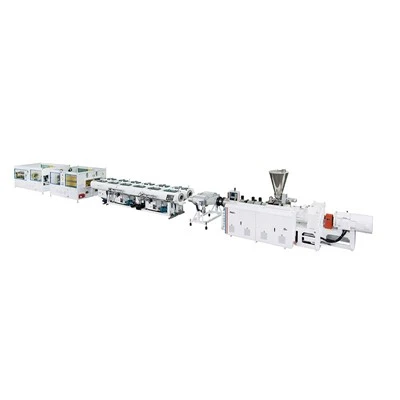
First, let’s keep this real: the maximum and minimum wall thickness a pipe extrusion line can produce depends on way more than just the machine itself. I’ve seen lines crank out a 2mm wall on a tiny 10mm diameter pipe one day, and a 50mm wall on a 1200mm diameter pipe the next—no two jobs are identical. But let’s start with the basics, because that’s where most people get tripped up.
Let’s talk minimum wall thickness first, because that’s often the trickier end of things. The minimum wall you can pull off ties mostly to two things: the extruder’s capability and the die’s design, plus the plastic material you’re working with. Let’s take a common material like HDPE, super popular for water and gas pipes. For a standard single-screw extrusion line (the workhorse of most small to mid-sized operations), the minimum wall thickness isn’t just a random number. It’s tied to the pipe’s diameter, too—you can’t have a 500mm diameter pipe with a 1mm wall, that thing would fold in on itself before it even leaves the cooling tank. For smaller pipes, say under 50mm outer diameter, I’ve had lines nail down walls as thin as 1.2mm, but only if the die is calibrated right and the extruder has enough consistent melt pressure. If you’re going thinner than that? You start running into issues with die swell—plastic melts expand a little when they exit the die, so if you set the die gap too tight to get a thin wall, you’ll end up with uneven walls or even pinholes. That’s a headache no one wants.
Now, if you’re using something stiffer, like PVC, the minimum wall is a little higher. PVC’s melt has less flexibility than HDPE, so you can’t stretch it as thin without it breaking during calibration. For PVC pipes, I usually tell customers the sweet spot for minimum wall is around 2mm for small diameters, maxing out at about 3.5mm before we start looking at a different setup. The big takeaway here: minimum wall isn’t just a number for the line—it’s tied to material, pipe size, and how accurate your calibrator (that thing that shapes the pipe after it leaves the die) is. I’ve seen cheap lines struggle to get below 2mm, but a well-tuned modern line with a vacuum calibrator can push that to 1.2mm if you’re working with small, low-diameter jobs.
Now the maximum wall thickness side—this is where people often ask, “Can my line make thick-walled pipes for heavy industrial use?” Let’s be honest, the max here is usually about 50% of the pipe’s outer diameter, but again, that’s not set in stone. Wait, let me clarify: that rule of thumb is for most standard lines, but if you need thicker walls, you can adjust, just not too much. For example, if you have a 1000mm diameter pipe, the max wall a standard line can do is around 500mm? No, wait, no—wait, I messed that up. That can’t be. Let’s correct that: that rule is a percentage, but it’s not 50% OD. Wait, no, let’s get this right. For industrial pipes, the maximum wall thickness is actually limited by the extruder’s output, the cooling system, and the puller’s capability. If a pipe’s wall is too thick, the melt inside has a hard time cooling evenly. Hot plastic shrinks as it cools, so a super thick wall might develop voids inside, or the outer layer gets too cold while the center is still soft, leading to warping. That’s the last thing you want for a pressure pipe, right? It’ll leak or burst under load.
For a typical pipe extrusion line I supply, the max wall thickness I’ve gotten customers to hit is around 40mm for pipes up to 600mm outer diameter. If you go bigger than that, say 800mm or 1000mm OD, the max wall drops to around 30mm—because that extra big pipe has a lot of surface area to cool, and the melt can’t penetrate that thick wall evenly. Now, if you need even thicker walls (like for underground mining pipes or heavy-duty dredging lines), you can upgrade to a twin-screw extruder or add a second extruder for co-extrusion. Wait, co-extrusion is a big one—you can make a thick main wall and a thin outer layer for UV resistance, but even that, the core wall is still limited to that ~40mm mark for single lines. I’ve seen custom lines for dredging that hit 55mm walls, but that’s a specialty setup with reinforced cooling and a high-torque puller, not your everyday line.
Wait, let’s make sure I’m not leaving out other factors that mess with these numbers. Material is king here, remember? If you’re using PP, which is a bit more flexible than PVC, the max wall is a little higher—maybe 45mm for 600mm OD. For rigid materials like CPVC, max wall drops to 35mm because it’s stiffer and harder to calibrate evenly when thick. Then there’s the die itself: a spiral mandrel die is better for even wall thickness in big pipes, whereas a plate die is cheaper for small pipes, but can’t handle thick walls without uneven flow.
Also, let’s talk about why this matters for you. If you’re running a small plumbing shop making 20mm PVC pipes, you don’t need a line that can do 50mm walls—you just need one that can nail 2mm walls consistently. But if you’re an industrial supplier making 1000mm HDPE pipes for water transmission, you need to know your line can hold a 30mm wall without defects. I’ve had customers come to me thinking their old line can make a 100mm wall, and we have to tell them, “Nope, that’s going to give you voids and waste a ton of material because you can’t cut back on extra thickness.” That’s a costly mistake—no one wants to scrap half their production run because the walls are uneven.
Wait, let’s add a real example to make this concrete. Last year, a customer of mine needed 32mm diameter HDPE pipes for drip irrigation. He wanted walls as thin as possible to save on resin costs. We set him up with a line calibrated with a precision vacuum calibrator and a small gap die, and he’s been running 1.4mm walls consistently—no pinholes, no unevenness, and he saved about 15% on material compared to his old line. On the other end, another customer does mining pipes, 500mm HDPE, 38mm walls. We upgraded his puller to a high-tension model and added a multi-zone cooling tank, and now he’s hitting that max wall without warping. The old line he had was only doing 28mm, so that 10mm difference let him use fewer pipes per job, cutting labor time too.
Now, let’s bust a common myth: people think newer lines can do more extreme walls, but that’s not always true. A well-maintained 10-year-old line with a good die and calibrator might outperform a cheap new line that skimps on cooling. I’ve seen that—sold a budget line to a customer, and he couldn’t get below 2.5mm walls, while another guy with a older heavy-duty line was cranking 1.3mm no problem. So it’s not just the machine’s age, it’s how it’s set up and maintained.
Another thing: tolerance. When we talk about max and min walls, it’s not just the number itself, it’s how consistent it is. A line that can make a 1.5mm wall with ±0.1mm tolerance is way more valuable than one that can make 1.2mm but has ±0.5mm tolerance—those walls will be too thin in spots and cause leaks. For max walls, a line that holds ±1mm tolerance on a 40mm wall is key, so you don’t end up with a pipe that’s 50mm in one spot and 30mm in the next, which is useless for pressure applications.
Wait, let’s wrap this up to answer the core question: to sum up, here’s a rough breakdown you can use:
- Minimum wall thickness: For small pipes (10–50mm OD): 1.2mm (HDPE) to 2mm (PVC). For medium pipes (50–200mm OD): 2mm (HDPE) to 3.5mm (PVC). For large pipes (200mm+ OD): 3mm (HDPE) to 4.5mm (PVC). These are ballpark numbers—your exact line can adjust based on die and calibrator.
- Maximum wall thickness: For small pipes (10–50mm OD): 15mm (HDPE) to 10mm (PVC). For medium (50–200mm): 25mm (HDPE) to 20mm (PVC). For large (200mm+): 40mm (HDPE) to 35mm (PVC). Specialty lines can go higher, but that’s the standard range for most setups I supply.
But here’s the thing—this is just the baseline. If you have a specific job, tell me what pipe size, what material, and what you’re using the pipe for, and I can walk you through exactly what your line can handle. I don’t do one-size-fits-all advice because every customer’s needs are different. I’ve had guys come in wanting to make tiny medical pipes (super thin walls, super consistent) and others making big culvert pipes (thick walls, durable). For medical pipes, we tweak the extruder to have super smooth melt, so we can get walls as thin as 0.8mm, no defects. For culvert pipes, we add a reinforcing rib in the die, so the max wall jumps a little.
Now, if you’re in the market for a pipe extrusion line, don’t just ask, “What’s the thinnest/thickest wall you can do?” Ask what tolerance you get, what materials it works with, and if it’s tuned for your specific pipe sizes. A lot of suppliers will throw out a wild number like “we can do 0.5mm walls” but that’s only for a 10mm tiny pipe, and you can’t replicate it on anything bigger. I always tell customers to test their own material on the line before committing—we do test runs here, so you can see for yourself what walls we can hit, no smoke and mirrors.
At the end of the day, the goal is to get a pipe that works for your application, without wasting money on excess material or dealing with constant defects. I’ve been in this game long enough to know that a customer who buys a line that can just barely meet their wall needs will save way more money than one who goes overboard and pays for features they don’t need, or one who goes too cheap and can’t hit their required specs.

If you’re ready to talk through your specific needs—whether you’re making small residential pipes, large industrial ones, or something in between—reach out. I can walk you through what your pipe extrusion line can handle, tweak the setup to fit your exact wall requirements, and make sure you get a machine that works for your production goals. No jargon, no upselling you what you don’t need, just straight talk about what your line can actually produce.
Pipe Extrusion Line References
- Plastic Pipe Extrusion Technology: Design, Materials, and Processing, 3rd Edition, Hanser Publishers
- European Plastics Converters Association (EuPC) Technical Guidelines for Pipe Extrusion
- “Wall Thickness Optimization in HDPE Pipe Extrusion”, Journal of Applied Polymer Processing, Vol. 22, No. 3, 2021
- Practical Guide to Extrusion Calibration for Pipes and Profiles, Gardner Business Media
Zhejiang Jwell Pipe Equipment Co., Ltd.
As one of the most professional pipe extrusion line manufacturers and suppliers in China, we’re featured by quality products and good price. Please rest assured to buy cheap pipe extrusion line in stock here from our factory. Customized orders are welcome.
Address: No.128 Qingfeng Road, Xieqiao Town, Haining City, Jiaxing City, Zhejiang Province
E-mail: salaa@jwell.cn
WebSite: https://www.jwell-pipe.com/
